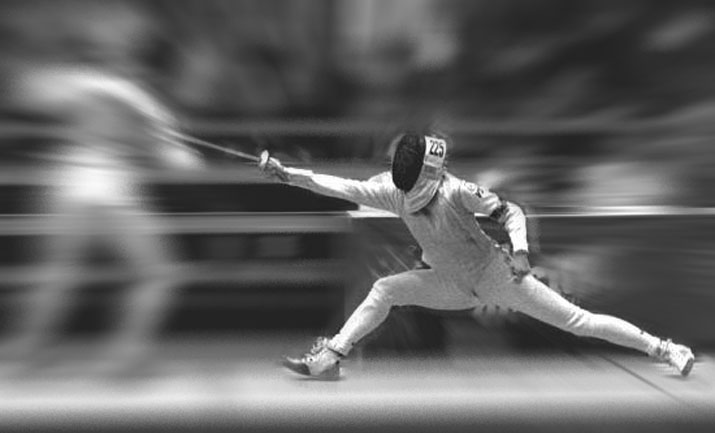
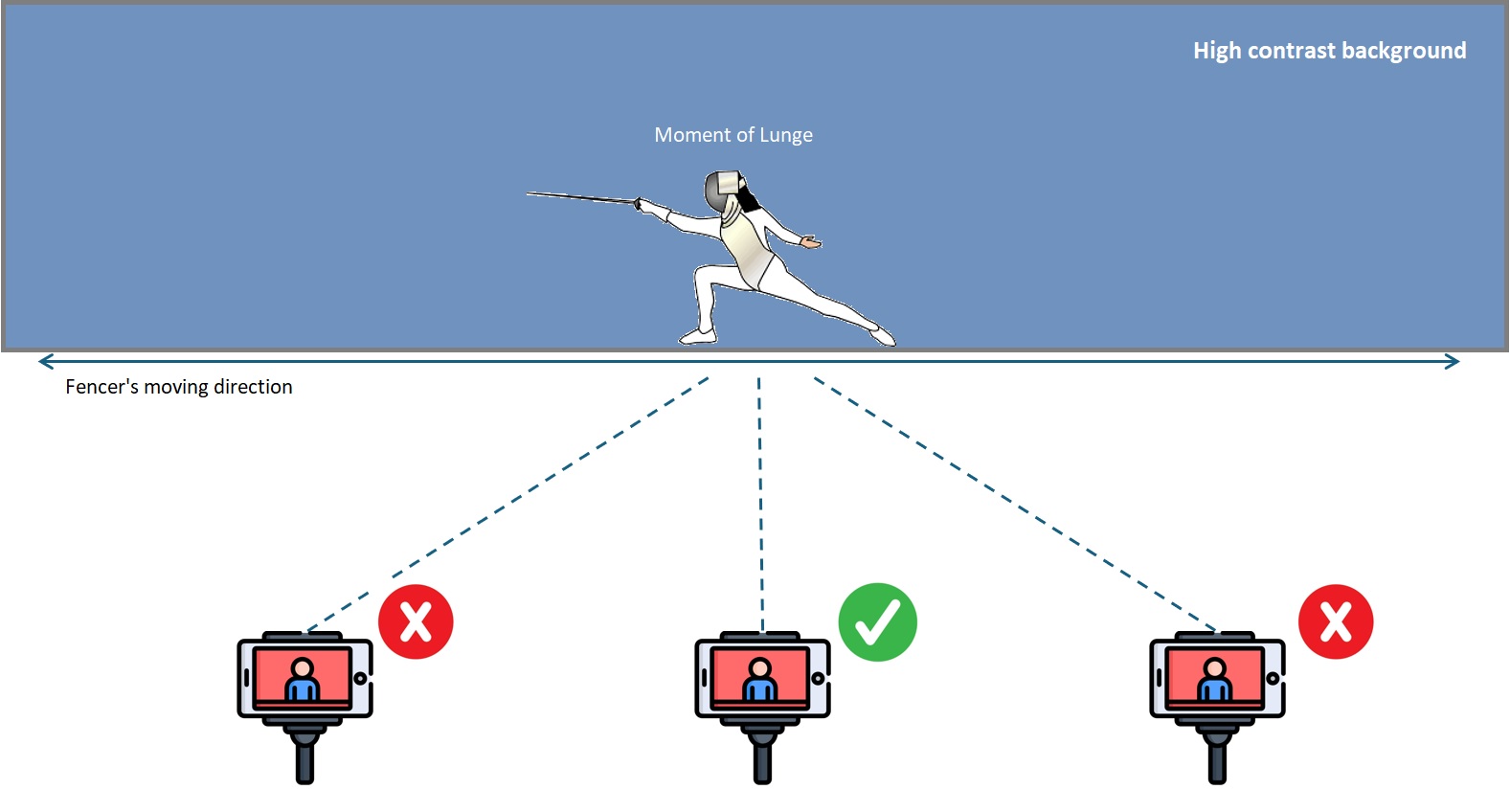
Use a high contrast background to ensure AI tracking accuracy.
Start recording by having camera focused on the fencer. This helps AI to lock the target from the beginning of the video.
The moment of lunge should be video-captured right in front of the camera.
Capturing the lunge with a side angle as shown in the picture will yield inaccurate analysis.
Make sure the whole body of the fencer is captured for the entire recording.
You can move the camera along with fencer moving direction, but keep the same distance between camera and fencer.
Do not change zoom setting during video recording.
The video duration should be around a few seconds (less than 10 seconds) to keep the processing time as a few minutes.
Refresh page (CTRL+F5) before choosing a validation sample video.
Choose a sample video:
×
Video Analysis Completed
Default explanation text...
Default explanation text...
Default explanation text...
Default explanation text...
Default explanation text...
Default explanation text...
Default explanation text...
Default explanation text...
Lunge Overall Score:
Default explanation text...
To master the fencing lunge, you must balance explosive power with mechanical safety.
The "Perfect Lunge" Checklist:
Small Preparatory Step (gain massive distance).
Hand moves first (creates the opening).
Front heel kicks out (initiates the distance).
Back leg snaps straight (provides the power).
Back arm whips back (maintains balance).
Front knee stays over the ankle (protects the joint).
Knee-Heel Alignment Score:
Default explanation text...
The most common cause of injury is "over-lunging" or poor alignment that forces the knee to absorb momentum it isn't positioned to handle.
Heel-First Landing: Always land on your front heel first, then roll the foot flat. Landing flat-footed or on your toes sends a shockwave directly into the patellar tendon.
Vertical Shin (The 90° Rule): In your final position, your front shin should be perpendicular to the floor. Your knee should be directly over your ankle—never extending past your toes.
Toe Alignment: Ensure your front foot is pointing exactly toward your opponent. If the foot is turned inward or outward, it creates lateral stress (knee valgus), which can strain the ACL or meniscus.
The "Kick" vs. "Step": A lunge is a push from the back leg and a kick from the front heel. Avoid "stepping" into it, which causes your weight to "dump" into the front knee.
Body Balance Score:
Default explanation text...
The non-weapon arm is not just for decoration; it acts as a stabilizer to prevent your torso from rotating or falling forward.
The Whip: As you push off with your back leg, "whip" your back arm down and back. It should end up parallel to your back leg.
Balance Effect: This backward motion creates a counter-force to the forward momentum of your lunge, helping you keep your torso upright and "square" rather than leaning too far forward.
The Recovery: When returning to En Garde, pull your back arm back up to its original position. This helps "yank" your torso back over your center of gravity.
A common mistake is "collapsing the chest" or leaning forward to gain extra reach. This actually makes your lunge shorter because it forces you to land sooner to avoid falling.
Stay Upright: Your spine should remain relatively vertical. Think of your hips "dropping" toward the floor rather than your head moving toward the opponent.
Weight Distribution: At the peak of the lunge, your weight should be supported by the "tripod" of your front heel and your back foot. If you feel like you are "toppling" onto your front leg, you have likely leaned your torso too far forward.
The "L" Frame: Ensure your shoulders and hips stay aligned and facing the side (for Foil/Épée) or slightly more forward (for Sabre). Rotating your torso during the lunge creates a "spinning" momentum that makes it impossible to recover quickly.
Hamstring Stretch Score:
Default explanation text...
In fencing, the hamstring of the lead leg is most vulnerable to "over-stretch" injuries (strains) during the "flight phase" and landing of the lunge. This occurs when the muscle is forced to lengthen rapidly while under high tension to decelerate the leg.
Hamstring Strain: A hamstring strain often happens because the muscle isn't strong enough to act as a "brake" during the explosive extension of the lunge. Traditional curls aren't enough; you need exercises that focus on the lengthening.
Static Stretches: One of the most common mistakes is performing "static" stretches (holding a reach for 30+ seconds) before fencing. This can actually temporarily weaken the muscle fibers and increase injury risk.
Avoid "Over-Reaching": Don't try to gain extra distance by locking out your front knee at the very end of the lunge. If your knee snaps into a full lock, the hamstring takes a massive shock. Keep a "micro-bend" or land with the intent to "sink" into the leg.
The "Kick" Angle: Aim to kick your front foot forward, not upward. A high-arcing kick stretches the hamstring significantly more at the peak of the lunge than a low, skimming-the-floor kick.
Lunge Effectiveness Score:
Default explanation text...
To maximize both the distance and speed of your lunge, you must focus on the coordination between your two legs and the "tempo" of your movement. Think of the lunge not as a single "step," but as a synchronized explosion of your entire frame.
Front Leg (The Accelerator): Don't just step forward. Lift your front toes slightly and kick your front heel toward the opponent. This "unlocks" your center of gravity and allows your weight to begin falling forward before the back leg even pushes.
Back Leg (The Engine): The back leg provides the power. As your front heel kicks out, the back leg must snap straight with explosive force. A common mistake is a "lazy" back leg that remains bent; for maximum distance, the back leg must be fully locked at the end of the lunge.
The "Flight" Phase: In a high-speed lunge, there is a split second where your body is essentially airborne. To increase distance, focus on staying low to the ground during this flight. High arcs waste energy upward instead of forward.
Forward Bias: For a faster "snap" lunge, many elite fencers shift their weight slightly forward in their En Garde stance (roughly 60/40 on the front leg). This allows the lunge to trigger instantly because your center of mass is already leaning toward the target.
Hip Rotation: At the moment of the lunge, ensure your hips are tucked under your torso (neutral pelvis). If your "butt is out," your back leg cannot push through its full range of motion, cutting your distance by several inches.
The Advance-Lunge Acceleration: Instead of a steady-speed advance followed by a lunge, use a Change of Pace. Make your first step slow and small, and then make the final lunge sudden and explosive. This "stolen tempo" makes the lunge appear much faster to your opponent's eyes.
Small Preparatory Step: To gain massive distance, take a very small, fast "preparatory" step (a "half-advance") right before the lunge. This gets your feet moving and creates momentum that you can then "launch" into the full lunge.